 0
0
 0
0
1. The applicant alleges that he belonged to the lowest caste of “pariahs” in the informal hierarchy that, according to him, prevails in Moldovan prisons, and that on account of that status he was subjected to restrictions, humiliations and forced labour. The application raises questions primarily under Articles 3, 4 and 14 of the Convention.
THE FACTS
2. The applicant was born in 1983; he was detained in Chișinău at the time the application was introduced.
3. The Government were represented by their Agent, Mr D. Obadă.
4. Convicted of aggravated murder, the applicant served a prison sentence between 2006 and 2021. From an unspecified date until February 2014, he was detained in Penitentiary Establishment no. 15 in Cricova. From February 2014, except for a short period between August and September 2017, he was detained in Penitentiary Establishment no. 9 in Pruncul.
5. The applicant submits that in February 2009 he was “demoted” to the lower “caste” of detainees, referred to as the “untouchables”, the “humiliated” or the “pariahs”. He does not specify the reasons for this “demotion”.
6. The “caste” system prevailing in Moldovan prisons is associated with an informal hierarchy of detainees and is a legacy of the Soviet period that has persisted since the Republic of Moldova’s independence. Similar systems are described in the judgments S.P. and Others v. Russia (nos. 36463/11 and 10 others, §§ 5-10, 2 May 2023) and D. v. Latvia (no. 76680/17, § 6, 11 January 2024). They are based on at least three “castes”: a group at the top of the informal hierarchy, the middle caste, to which the vast majority of detainees belong, and the lowest “caste”, that of the “pariahs”.
THE APPLICANT’S VERSION OF THE TREATMENT RESERVED FOR “PARIAHS”
7. The applicant submits that, like other detainees belonging to the lowest “caste”, he was required to observe strict rules of conduct, which he describes as follows.
8. The applicant states that in order to move around the prison, he was obliged to walk along the walls and fences. He explains that “pariahs” were prohibited from touching a detainee from another “caste”, on pain of physical reprisals. He specifies that if a detainee was touched by a “pariah”, he himself became one, and that as a result, persons belonging to the lowest “caste” were constantly chased away by other detainees.
9. The applicant further submits that “pariahs” received their meals separately from others. He states that in Penitentiary no. 15 in Cricova, “pariahs” were served last, on a plate placed on the floor, and that those concerned then had to lean down to pick up the plate, step back two paces, then stand up and turn to go and eat in their cells. He adds that in Penitentiary no. 9 in Pruncul, he received his meals at the window of the dishwashing area, where sanitary conditions were, in his view, deplorable.
10. The applicant states that he was seen last by the prison doctor, even if he had registered first. He explains that if, during a “pariah”’s examination by the doctor, another detainee entered the room, the “pariah” had to leave immediately and wait until the doctor had finished examining that detainee.
11. According to the applicant, “pariahs” were also prohibited from going to the prison church, using the laundry, the gymnasium, or attending vocational training courses.
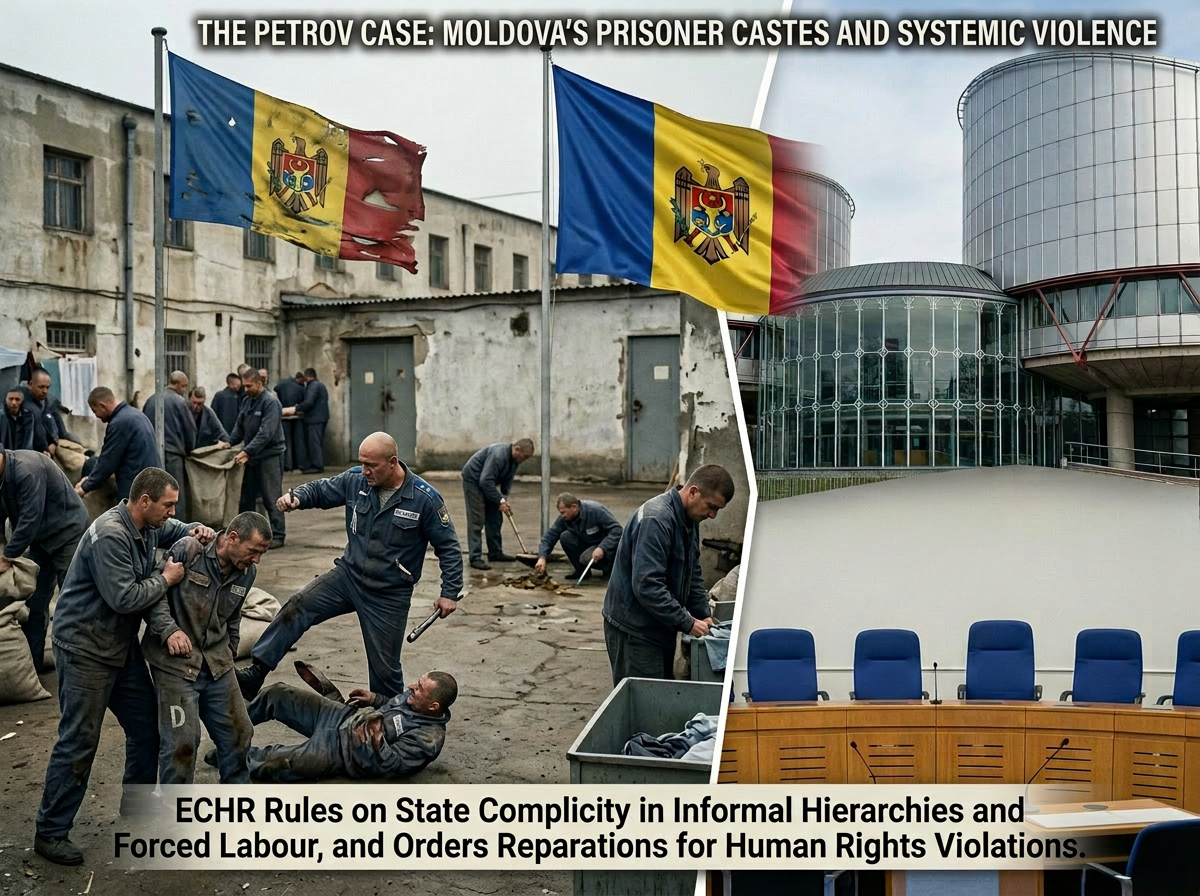
12. The applicant further submits that he was forced to carry out tasks to which other detainees were not subjected. He alleges in particular that he had to carry out renovation work in cells, sometimes for up to 14 hours a day, and to carry on his back, from outside to certain cells, bags filled with stones. He also says that he was forced to work outdoors in scorching heat, without water or breaks. He submits that he was not paid and, moreover, that he performed tasks for which other detainees were paid in his place. He adds that as a “pariah”, he also had to collect rubbish and other waste within the prison, clean the toilets, move coal, or carry buckets full of concrete for up to ten hours at a stretch over a distance of 500 metres.
13. The applicant provided the Court with several videos that he claims to have recorded on his mobile phone in Penitentiary no. 9 in Pruncul. He did not specify their date.
14. In the first video, the applicant films his cell, which is in a dilapidated state, as well as three fellow inmates, one of whom is busy doing construction work. The applicant states, inter alia, that the persons concerned are “pariahs”, which is confirmed by two other detainees, and that they have to carry out work in their cell alone, unlike detainees from other “castes” whose cells are renovated by workers.
15. In three other videos, he films the same cell undergoing renovation. He states that he and the other detainees occupying it are forced to do construction work there all day, that he is rarely allowed to leave his cell, that he is not permitted to use the shower – which is reserved for detainees of the “higher caste” – and that he is forced to sleep in the cell while it is full of dust and debris. In another of these videos, the applicant can be seen plastering a wall in the cell, claiming that he and his cellmates have been forced for seven days to work more than twelve hours a day and to sleep in this cell, breathing the dust and fumes generated by the construction work.
16. In another video, the applicant shows the cell now renovated, but whose walls are beginning to deteriorate due to moisture, with a leaking ceiling when it rains. He states that there are seven of them in the cell. The footage shows four beds, including three bunk beds, and the very limited space available to detainees outside these beds.
17. In two other videos, the applicant films himself asking a detainee from another “caste” for permission to leave his cell.
18. In another video, the applicant films with a hidden camera the prison yard and a discussion with another detainee, from which it emerges that both of them are “pariahs” and must walk along the walls of the yard, keeping away from detainees from other “castes”.
19. In yet another video, the applicant films with a hidden camera the route he takes to the dining hall and the interior of it. He walks along an exterior wall, behind another “pariah”, and once in the dining hall, he receives his meal at a window which he says is not the same as the one used by detainees from other “castes”.
THE COMPLAINTS LODGED BY THE APPLICANT
20. In a series of complaints addressed to Penitentiary no. 9 in Pruncul between February 2017 and September 2018, the applicant requested to be assigned paid work, in vain. In one of them, he mentioned his membership of the “caste of pariahs”.
21. At the same time, on 2 February 2017, the applicant lodged a complaint before an investigating judge denouncing his conditions of detention and the discrimination he claimed to be suffering within Penitentiary no. 9 in Pruncul. He mentioned his “pariah” status and alleged that when he or other detainees in his cell complained about their conditions of detention, the prison administration would have a detainee from a higher caste come and tell them to be silent.
22. By a judgment of 7 February 2017, the Chișinău District Court declined jurisdiction and transmitted the applicant’s complaint for examination to the Department of Penitentiary Establishments of the Ministry of Justice.
23. By a letter of 27 March 2017, that department informed the applicant that, after verification, it had detected no breach of the applicable legislation of the Republic of Moldova on the part of the officials of Penitentiary no. 9 in Pruncul. It also stated that it was implementing all necessary measures to ensure safety and to create favourable conditions of detention for persons detained.
24. In the meantime, on 24 March 2017, the applicant had applied to the investigating judge to denounce his conditions of detention. In his complaint, he had again specified that he belonged to the “caste of pariahs”.
25. By a judgment of 3 April 2017, the Chișinău District Court again declined jurisdiction and transmitted the complaint to the Department of Penitentiary Establishments of the Ministry of Justice.
26. By a decision of 18 May 2017, the department closed the proceedings without having examined them, on the ground that the applicant had refused in writing to receive a reply to his complaint.
27. At an unspecified date in 2019, the applicant applied to the Council for the Prevention and Elimination of Discrimination and Ensuring Equality (“the Equality Council”). He explained that he had sent several requests to the prison administration in order to obtain employment, and that all his requests had been refused. He also submitted that he and a group of detainees, members of the “caste of pariahs”, were working without remuneration.
28. In its decision of 12 July 2019, the Equality Council noted that during his detention in Penitentiary no. 9 in Pruncul, the applicant had committed twenty-four disciplinary offences, and that he still had three unspent disciplinary offences. It concluded that there was no causal link between the differential treatment alleged by the applicant and the elements he had invoked, and that this treatment was instead the result of the disciplinary offences mentioned.
TEXTS OF THE EUROPEAN COMMITTEE FOR THE PREVENTION OF TORTURE
30. The report to the Government of the Republic of Moldova on the ad hoc visit to the Republic of Moldova carried out by the European Committee for the Prevention of Torture and Inhuman or Degrading Treatment or Punishment (CPT) from 5 to 13 December 2022 [CPT/Inf (2023) 27], published on 13 September 2023, reads as follows in its relevant passages [Registry’s translation]:
SUMMARY OF THE REPORT
The main objective of the 2022 ad hoc visit was to re-examine the treatment and conditions of detention of persons in custody. (…) Particular attention was paid to the assessment of progress made by the Moldovan authorities in combating violence and intimidation among detainees.
(…) While the CPT noted progress in some areas, it regrets that many key recommendations, repeatedly formulated in its previous visit reports [see in particular the reports on the visits conducted in 2015 [CPT/Inf (2016) 16], 2018 [CPT/Inf (2018) 49] and 2020 [CPT/Inf (2020) 27]], remain unimplemented. This finding relates, in particular, to the recommendations concerning the phenomenon of informal hierarchy among prisoners and the resulting violence and intimidation, the poor material conditions to which the majority of detainees are subjected, the limited programme of activities offered to detainees, and the staffing levels, which are insufficient to ensure effective supervision of penitentiary establishments. (…)
As noted above, the visit’s findings highlight that violence among detainees remains a largely unresolved problem and that, in general, penitentiary establishments still fail to provide a safe environment for detainees. Once again, a large number of detainees described to the delegation a general atmosphere of intimidation and violence generated by informal prisoner leaders and their entourage. Documents examined by the delegation also revealed multiple cases of injuries characteristic of inter-prisoner violence. Out of fear and lack of trust in the capacity of the staff to ensure their protection, injured detainees refused to provide explanations as to the origin of their injuries. Moreover, although all these cases were established and reported to the prosecutor’s office, no investigation was opened in these cases.
The situation of persons considered as “humiliated” or “untouchables”, i.e. those belonging to the lowest “caste” of the informal hierarchy of detainees, remains a major concern for the CPT. Once again, the delegation received numerous complaints of frequent verbal abuse, systematic degrading behaviour from other detainees and threats of physical violence. As it has emphasised on several occasions in its previous visit reports, the CPT considers that the situation of these persons could be characterised as constituting a continuing violation of Article 3 of the European Convention on Human Rights. (…)
The CPT considers that the persistent inability of the Moldovan authorities to ensure a safe and secure environment for detainees is directly linked to several factors, including chronic shortages of prison staff, reliance on informal prisoner leaders to maintain control over the prison population and the existence of large-capacity dormitories. At the same time, there is no genuine individualised assessment of risks and needs at admission, nor any classification to determine in which prison, block or cell each newly admitted detainee should be placed. (…)
31. The response of the Moldovan Government to the CPT report on the visit from 5 to 13 December 2022 [CPT/Inf (2023) 32], published by the CPT on 3 November 2023, acknowledges the need to develop a strategic document to guide the measures taken by the authorities to combat this deeply rooted phenomenon [of informal hierarchy among detainees] within Moldovan penitentiary establishments, while noting that at the time, it was not possible to draw up a programme to address this specific prison problem as no strategy provided for or mentioned such a programme. The response further states that the Ministry of Justice had assessed the degree of implementation of recommendations from the 2018 baseline study, finding that only 20% of recommendations had been implemented. It indicates that a roadmap for reducing the informal hierarchy would be approved, incorporating actions reflecting the measures recommended in the CPT’s report.
32. In its report on the ad hoc visit to the Republic of Moldova from 3 to 12 June 2025 [CPT/Inf (2025) 38], published on 4 December 2025, the CPT reaffirms that the condition of “pariah” detainees remains a major cause for concern.
33. The CPT’s penitentiary standards on informal hierarchy among detainees [CPT/Inf (2025) 12] describe the “caste” system in post-Soviet prison systems in detail, including the lowest caste of the “untouchables” or “pariahs” (opushchennye, levyje), who: are not permitted to have an opinion on life in the establishment or on the higher castes, to raise their voice or to physically resist when struck by a person from a higher caste; must stand guard for hours at the entrance to the unit; are placed in separate cells; must use separate sanitary facilities; eat at separate tables in the dining hall from identifiable crockery; cannot use the unit kitchen; are responsible for all cleaning of common areas; and perform cleaning in dormitories and cells of the upper caste. The CPT standards note that this situation “could be considered as constituting a continuing violation of Article 3” and that the exploitation of lower-caste detainees “could amount in some cases to modern slavery (in the form of forced labour)”.
34. The baseline study on criminal subculture in prisons of the Republic of Moldova, conducted within the Council of Europe project “Support to Criminal Justice Reforms in the Republic of Moldova”, published in March 2018, confirms that criminal subculture exists in all Moldovan prisons to varying degrees, is enforced through centralised structures in male adult establishments, and that the caste system is “the cornerstone of the violence distribution mechanism”. The lowest caste – the “untouchables” – faces the most severe deprivations and the highest daily risk of victimisation.
35. The European Prison Rules of 2006, adopted by the Committee of Ministers of the Council of Europe on 11 January 2006 and revised on 1 July 2020 (Recommendation Rec(2006)2-rev), provide inter alia that restrictions on persons deprived of their liberty shall be reduced to the minimum necessary; that prison life shall be aligned as closely as possible with positive aspects of life in the community; that work in prison shall be considered a positive element of the prison regime and shall in no case be imposed as a punishment; and that the maximum daily and weekly hours of work by prisoners shall be fixed in conformity with local rules and customs regarding employed workers outside.
ALLEGED VIOLATION OF ARTICLE 3 OF THE CONVENTION IN CONJUNCTION WITH ARTICLE 14
42. Relying on Article 14 of the Convention, the applicant alleges that he was subjected to discrimination, humiliation and prohibitions in prison on account of his belonging to the caste of “pariahs”.
43–46. The Court, being master of the characterisation to be given in law to the facts of a case, considers that the complaint calls for examination under Article 3 of the Convention (S.P. and Others v. Russia, § 65, and D v. Latvia, §§ 30 and 58). The duty on the authorities to prevent discriminatory violence by private individuals and to investigate possible discriminatory motives can simultaneously be regarded as part of the responsibilities of the authorities under Article 14 to ensure the fundamental values protected by Article 3 without discrimination. Given the interaction between these provisions in the context of discrimination-motivated violence, such questions may be examined under Article 3 alone, or require simultaneous examination under both Articles. The Court considers that the most appropriate approach in the present case is to examine the applicant’s complaint under Article 3 taken in conjunction with Article 14.
61–68. Establishment of the facts. The Government does not contest the applicant’s assertion that he belonged to the “caste of pariahs” nor the reality of the “caste” system. The Court notes that the existence of an informal hierarchy of detainees in Moldovan prisons is a notorious fact documented by the CPT and a detailed study; that the applicant’s membership of the lower “caste” is confirmed by other detainees in the videos he provided, including a fellow “pariah” filmed without his knowledge; and that the applicant describes a climate of restrictions and humiliations. Accordingly, the Court finds it established that the applicant belonged to the lower “caste” and that he was subjected to at least some of the treatments complained of – namely physical and social segregation, denial of access to certain basic prison resources, and assignment to menial tasks, imposed by other detainees on account of his “pariah” status.
69–72. Severity threshold. The applicant’s situation is substantially similar to that of the applicant in D. v. Latvia (§ 49), where the Court already concluded that segregation sent a powerful message of inferiority, thereby undermining the human dignity of detainees in the applicant’s situation and thus amounting to degrading treatment under Article 3. The Court sees no reason to adopt a different approach in the present case. The stigmatisation and physical and social segregation suffered by the applicant, together with his assignment to menial tasks and denial of access to basic prison resources, caused him anguish and physical suffering necessarily exceeding the inevitable level of suffering inherent in detention, even in the absence of physical violence. This situation, endured by the applicant for years, amounts to degrading treatment, and the minimum threshold of severity required to engage Article 3 in conjunction with Article 14 has been reached.
73–85. Positive obligation to protect without discrimination. The Court reiterates that national authorities are under an obligation to take measures capable of preventing persons within their jurisdiction from being subjected to torture or inhuman or degrading treatment, even at the hands of private individuals. The Court observes that the applicant repeatedly informed the prison administration, judges and other State authorities that he belonged to the “caste of pariahs”. Given that the phenomenon is widely documented, the State authorities, having been alerted to the applicant’s subordinate position, could not have been unaware of the risks to which his situation of vulnerability exposed him. Yet the national authorities implemented no measures to make the applicant less vulnerable, and there is no indication that any effective mechanisms existed to address the broader question of established hierarchies among detainees.
The Court further considers that no difference in treatment based on forced membership of an inferior “caste”, whose members are dehumanised and denied recognition of their mere existence as human beings, could be objectively justified. The authorities had full knowledge of the gravity and extent of the problem of informal hierarchy in Moldovan prisons and its discriminatory effect on detainees considered as “pariahs”, yet took no steps to remedy it. The failure of the State to offer the applicant protection against the degrading treatment he was suffering amounts to a violation of his right to equal protection of the law.
Conclusion: There has been a violation of Article 3 of the Convention in conjunction with Article 14, on account of the State authorities’ failure to protect the applicant without discrimination against treatment prohibited by the former provision.
ALLEGED VIOLATION OF ARTICLE 4 OF THE CONVENTION
86. The applicant alleges that on account of his “pariah” status, he was forced to perform forced labour during his detention. He relies on Article 4 § 2 of the Convention, which provides that no one shall be required to perform forced or compulsory labour. Article 4 § 3 (a) states that work required to be done in the ordinary course of detention imposed according to the provisions of Article 5 shall not be considered “forced or compulsory labour”.
87–93. Parties’ submissions on admissibility and merits. The Government raised the same exceptions as under Article 3, which the Court rejected for the same reasons. The Government submitted that the applicant had carried out remunerated and unremunerated work within the permitted number of hours and that the legislation clearly provided for an obligation to perform certain unremunerated tasks. The applicant maintained that from the moment of his “demotion” he was compelled to perform forced labour beyond the regulatory norm, carrying out tasks that should have been performed by paid detainees.
94–103. General principles. Article 4 enshrines one of the fundamental values of democratic societies. “Forced labour” implies physical or moral coercion; “obligatory labour” denotes work exacted under the menace of a penalty and performed against the will of the person concerned, who has not offered himself/herself voluntarily. The notion of “penalty” must be understood broadly and may take the form of psychological coercion. Article 4 § 3 (a) delimits the very content of the right guaranteed by Article 4 § 2. In assessing what constitutes “work normally required of a person detained”, the Court takes into account the purpose of the work imposed, its nature, extent and manner of execution, as well as standards prevailing in Council of Europe member States. A work normal in itself may prove abnormal if discrimination guides the choice of those required to perform it.
105–107. Application of principles to the present case. The Court applies the same standard of proof as under Article 3. The applicant’s allegations of renovation work are supported by the videos he provided. His allegations concerning other tasks (rubbish collection, cleaning toilets, carrying heavy loads) are corroborated by publications confirming that arduous and menial tasks in prisons are generally performed by “pariahs”. The Government does not contest that various arduous and menial tasks were imposed on the applicant, or that they were imposed due to his “pariah” status. The Court accordingly finds it established that the applicant performed arduous and menial work imposed on account of his “pariah” status, with the agreement of the prison administration, which was aware both of his status and of the practice.
109. Whether tasks constituted “forced or compulsory labour”. The tasks assigned to the applicant were imposed pursuant to the informal “code of conduct” applicable to his “pariah” status, and non-compliance exposed him to reprisals from other detainees. Although the applicant does not report specific physical violence, the risk of suffering such violence or further humiliation if he refused to perform the assigned tasks was real. Given these elements of physical and moral coercion, the Court is satisfied that the applicant was performing work “under the menace of a penalty” for which he had not “offered himself voluntarily”.
110–114. Whether tasks fall within Article 4 § 3 (a). Following the approach in Meier, the Court examines the purpose, nature, extent and manner of execution of the imposed work. As to purpose, the work was clearly punitive, as the tasks formed part of the humiliations to which the applicant was subjected on account of his status. The work did not serve any important objective related, for example, to the applicant’s rehabilitation, but rather tended to further degrade him. As to the nature of work, the tasks were physically arduous and/or menial. The only criterion applied in assigning them was the applicant’s membership of the “pariah” caste – a clearly discriminatory distribution of work. These factors are sufficient for the Court to find that the work did not fall within the “normal” limits of Article 4 § 3 (a) and therefore constituted “forced or compulsory labour” within the meaning of Article 4 § 2.
115–118. Positive obligations. The State’s positive obligations under Article 4 include taking operational measures to protect actual or potential victims. The Court finds, as under Article 3, that the authorities were fully aware of the applicant’s situation and of the gravity of the problem, yet took no measures to protect him against the forced or compulsory labour associated with his membership of the “pariah” group.
Conclusion: There has been a violation of Article 4 § 2 of the Convention on account of the respondent State’s failure to fulfil its positive obligations to protect the applicant against treatment prohibited by that provision.
ALLEGED VIOLATION OF ARTICLE 9 OF THE CONVENTION
119–120. The applicant alleged under Article 9 that he was unable to attend the prison church. Having regard to the findings above, the Court considers that it has examined the main legal questions raised by the application and that there is no need to examine the admissibility and merits of this complaint separately.
FOR THESE REASONS, THE COURT, UNANIMOUSLY,
Declares admissible the complaints under Article 3 of the Convention in conjunction with Article 14, and under Article 4 § 2 of the Convention;
Holds that there has been a violation of Article 3 of the Convention in conjunction with Article 14 of the Convention;
Holds that there has been a violation of Article 4 § 2 of the Convention.
*******************************************
КАСТИ, ПРИМУСОВА ПРАЦЯ ТА НЕЗДАТНІСТЬ ЗАБЕЗПЕЧИТИ ЗАХИСТ: PETROV V. MOLDOVA — ЗНАКОВА СПРАВА ЩОДО НЕФОРМАЛЬНИХ В’ЯЗНИЧНИХ ЇЄРАРХІЙ
Заявник стверджує, що належав до нижчої касти «ізгоїв» у неформальній ієрархії, яка, за його словами, панує в молдовських в’язницях, і що через цей статус він зазнавав обмежень, принижень і примусової праці. Заява порушує питання передусім у контексті статей 3, 4 та 14 Конвенції.
ОБСТАВИНИ СПРАВИ
2. Заявник народився у 1983 році; на момент подачі заяви він тримався під вартою у Кишиневі.
4. Засуджений за вбивство при обтяжуючих обставинах, заявник відбував покарання у виді позбавлення волі з 2006 по 2021 рік. З невстановленої дати до лютого 2014 року він перебував у Пенітенціарній установі № 15 у Крікові. З лютого 2014 року, за винятком короткого періоду між серпнем і вереснем 2017 року, він тримався у Пенітенціарній установі № 9 у Прункулі.
5. Заявник стверджує, що у лютому 2009 року його «понизили» до нижчої «касти» ув’язнених, які іменуються «недоторканими», «приниженими» або «ізгоями». Підстав цього «пониження» він не уточнює.
6. «Кастова» система, що панує в молдовських в’язницях, пов’язана з неформальною ієрархією ув’язнених і є спадщиною радянського періоду, яка збереглася після здобуття Республікою Молдова незалежності. Аналогічні системи описані в рішеннях «С.П. та інші проти Росії» (заяви № 36463/11 та 10 інших, §§ 5–10, 2 травня 2023 року) та «Д. проти Латвії» (заява № 76680/17, § 6, 11 січня 2024 року). Вони базуються щонайменше на трьох «кастах»: групі на вершині неформальної ієрархії, середній касті, до якої належить переважна більшість ув’язнених, та нижчій «касті» — «ізгоїв».
ВЕРСІЯ ЗАЯВНИКА ЩОДО ПОВОДЖЕННЯ З «ІЗГОЯМИ»
7. Заявник стверджує, що він, як і інші ув’язнені, які належали до нижчої «касти», зобов’язаний був дотримуватись суворих правил поведінки, які він описує таким чином.
8. Заявник зазначає, що для пересування по в’язниці він був зобов’язаний ходити вздовж стін та огорож. Він пояснює, що «ізгоям» заборонялося торкатися ув’язненого з іншої «касти» під загрозою фізичних репресій. Він уточнює, що якщо ув’язненого торкався «ізгой», сам цей ув’язнений ставав «ізгоєм», і що внаслідок цього осіб, які належали до нижчої «касти», постійно проганяли інші ув’язнені.
9. Заявник також стверджує, що «ізгої» отримували їжу окремо від інших. У Пенітенціарній установі № 15 у Крікові «ізгоїв» обслуговували останніми: тарілку ставили на підлогу, і вони мали нахилитися, щоб підняти її, зробити два кроки назад, потім випрямитися і повернутися, щоб поїсти у своїх камерах. У Пенітенціарній установі № 9 у Прункулі він отримував їжу біля вікна посудомийної зони, де санітарні умови, на його думку, були жахливими.
10. Заявник стверджує, що в’язничний лікар приймав його останнім, навіть якщо він реєструвався першим. Якщо під час огляду «ізгоя» лікарем до кімнати заходив інший ув’язнений, «ізгой» мусив негайно вийти й чекати, поки лікар не закінчить огляд цього ув’язненого.
11. За словами заявника, «ізгоям» також заборонялося відвідувати в’язничну церкву, користуватися пральнею, спортивним залом або відвідувати курси професійної підготовки.
12. Заявник також стверджує, що його змушували виконувати роботи, яких не виконували інші ув’язнені. Зокрема, він зазначає, що мусив проводити ремонтні роботи у камерах іноді до 14 годин на добу, а також переносити на спині мішки, наповнені камінням, із вулиці до певних камер. Він також вказує, що його змушували працювати надворі під палючим сонцем, без води та перерв, без будь-якої оплати, і при цьому виконував завдання, за які платили іншим ув’язненим. Як «ізгой», він також мусив збирати сміття та інші відходи у в’язниці, прибирати туалети, перевозити вугілля або переносити відра з бетоном упродовж до десяти годин поспіль на відстань 500 метрів.
13. Заявник надав Суду кілька відеозаписів, які, за його словами, він зробив на мобільний телефон у Пенітенціарній установі № 9 у Прункулі. Дати відеозаписів він не вказав.
14. На першому відео заявник знімає свою камеру, яка перебуває у занедбаному стані, а також трьох співкамерників, один з яких зайнятий будівельними роботами. Заявник стверджує, що зазначені особи є «ізгоями», що підтверджують два інші ув’язнені, і що вони змушені самостійно виконувати роботи у своїй камері, на відміну від ув’язнених інших «каст», камери яких ремонтуються найманими робітниками.
15. На трьох інших відео він знімає ту саму камеру під час ремонту. Він стверджує, що його та інших ув’язнених, які перебувають у ній, змушують весь день виконувати будівельні роботи, що він рідко може вийти з камери, що йому не дозволяють користуватися душем – зарезервованим для ув’язнених «вищої касти» – і що він змушений спати в камері, повній пилу та будівельного сміття. На одному з відео видно, як заявник штукатурить стіну, стверджуючи, що впродовж семи днів він і його співкамерники змушені працювати понад дванадцять годин на добу і спати в цій камері, дихаючи пилом і випарами від будівельних робіт.
16. На іншому відео заявник показує відремонтовану камеру, стіни якої починають руйнуватися через вологість, а стеля протікає під час дощу. Він зазначає, що їх семеро у камері. На записі видно чотири ліжка, у тому числі три двоярусних, і вкрай обмежений простір, доступний ув’язненим поза цими ліжками.
17. На двох інших відео заявник знімає, як просить дозволу в ув’язненого з іншої «касти» покинути свою камеру.
18. На ще одному відео заявник знімає прихованою камерою в’язничний двір і розмову з іншим ув’язненим, з якої випливає, що обоє є «ізгоями» і мають ходити вздовж стін двору, тримаючись осторонь від ув’язнених інших «каст».
19. На ще одному відео заявник знімає прихованою камерою маршрут до їдальні та її інтер’єр. Він іде вздовж зовнішньої стіни, слідом за іншим «ізгоєм», і в їдальні отримує їжу біля вікна, яке, за його словами, відрізняється від вікна для ув’язнених інших «каст».
СКАРГИ ЗАЯВНИКА
20. У низці скарг, надісланих до Пенітенціарної установи № 9 у Прункулі з лютого 2017 по вересень 2018 року, заявник безрезультатно просив надати йому оплачувану роботу. В одній із скарг він згадав про своє членство у «касті ізгоїв».
21. 2 лютого 2017 року заявник подав скаргу до слідчого судді з приводу умов тримання під вартою та дискримінації, якої він зазнавав у Пенітенціарній установі № 9 у Прункулі. Він вказав на свій статус «ізгоя» і стверджував, що коли він або інші ув’язнені в його камері скаржилися на умови тримання під вартою, адміністрація установи надсилала ув’язненого з вищої касти, щоб той примусив їх замовкнути.
22. Рішенням від 7 лютого 2017 року Кишинівський районний суд відмовився від юрисдикції та передав скаргу заявника на розгляд Департаменту пенітенціарних установ Міністерства юстиції.
23. Листом від 27 березня 2017 року цей департамент повідомив заявника, що після перевірки не виявив жодних порушень чинного законодавства Республіки Молдова з боку посадових осіб Пенітенціарної установи № 9 у Прункулі. Також зазначалося, що вживаються всі необхідні заходи для забезпечення безпеки та створення сприятливих умов тримання для осіб, позбавлених волі.
24. 24 березня 2017 року заявник звернувся до слідчого судді зі скаргою на умови тримання під вартою, знову вказавши на свою належність до «касти ізгоїв».
25. Рішенням від 3 квітня 2017 року Кишинівський районний суд знову відмовився від юрисдикції та передав скаргу до Департаменту пенітенціарних установ Міністерства юстиції.
26. Рішенням від 18 травня 2017 року департамент закрив провадження, не розглянувши скаргу по суті, на тій підставі, що заявник письмово відмовився отримати відповідь на неї.
27. У невстановлену дату 2019 року заявник звернувся до Ради з попередження та ліквідації дискримінації і забезпечення рівності («Рада рівності»). Він пояснив, що надсилав кілька запитів до адміністрації в’язниці з метою отримання роботи, і всі вони були відхилені. Він також зазначив, що він і група ув’язнених — членів «касти ізгоїв» — працюють без винагороди.
28. У своєму рішенні від 12 липня 2019 року Рада рівності відзначила, що за час перебування у Пенітенціарній установі № 9 у Прункулі заявник вчинив двадцять чотири дисциплінарні правопорушення і що три з них ще не є погашеними. Рада дійшла висновку про відсутність причинно-наслідкового зв’язку між диференційованим поводженням, на яке посилається заявник, і наведеними ним підставами, та констатувала, що таке поводження є наслідком зазначених дисциплінарних правопорушень.
МАТЕРІАЛИ ЄВРОПЕЙСЬКОГО КОМІТЕТУ З ПИТАНЬ ЗАПОБІГАННЯ КАТУВАННЯМ
30. У відповідних частинах доповіді Уряду Республіки Молдова щодо спеціального візиту до Республіки Молдова, здійсненого ЄКЗК з 5 по 13 грудня 2022 року [CPT/Inf (2023) 27], опублікованої 13 вересня 2023 року, зазначено:
РЕЗЮМЕ ДОПОВІДІ
Основною метою спеціального візиту 2022 року було повторне вивчення поводження з особами, взятими під варту, та умов їх тримання. (…) Особлива увага приділялася оцінці прогресу молдовської влади у боротьбі з насильством та залякуванням серед ув’язнених.
(…) Хоча ЄКЗК відзначив прогрес у деяких сферах, Комітет з жалем констатує, що багато ключових рекомендацій, неодноразово сформульованих у попередніх доповідях про візити [зокрема, доповіді щодо візитів 2015 [CPT/Inf (2016) 16], 2018 [CPT/Inf (2018) 49] та 2020 [CPT/Inf (2020) 27] років], досі не виконані. Це стосується, зокрема, рекомендацій щодо явища неформальної ієрархії серед ув’язнених та пов’язаного з нею насильства й залякування, незадовільних матеріальних умов тримання більшості ув’язнених, обмеженої програми діяльності, що пропонується ув’язненим, а також рівня укомплектованості персоналом, недостатнього для забезпечення ефективного нагляду за пенітенціарними установами. (…)
Як зазначалося вище, результати візиту свідчать про те, що насильство серед ув’язнених залишається значною мірою невирішеною проблемою і що пенітенціарні установи, як правило, все ще не забезпечують безпечного середовища для ув’язнених. Знову чимало ув’язнених описували делегації загальну атмосферу залякування та насильства, яку створюють неформальні лідери серед ув’язнених та їхнє оточення. Вивчені делегацією документи також свідчили про численні випадки травм, характерних для насильства між ув’язненими. Зі страху та браку довіри до спроможності персоналу забезпечити їм захист постраждалі ув’язнені відмовлялися пояснювати походження своїх травм. Більш того, хоча всі ці випадки були встановлені та повідомлені прокуратурі, жодного розслідування у зв’язку з ними не порушувалось.
Становище осіб, яких вважають «приниженими» або «недоторканими», тобто тих, хто належить до нижчої «касти» неформальної ієрархії ув’язнених, залишається серйозним приводом для занепокоєння ЄКЗК. Делегація знову отримала численні скарги на часті словесні образи, систематичну принизливу поведінку інших ув’язнених та погрози фізичним насильством. Як ЄКЗК неодноразово підкреслював у попередніх доповідях про візити, він вважає, що ситуацію цих осіб можна охарактеризувати як таку, що є триваючим порушенням статті 3 Європейської конвенції з прав людини. (…)
ЄКЗК вважає, що стійка нездатність молдовської влади забезпечити безпечне та надійне середовище для ув’язнених безпосередньо пов’язана з кількома чинниками, зокрема з хронічною нестачею тюремного персоналу, покладанням на неформальних лідерів серед ув’язнених для підтримання контролю над тюремним населенням та існуванням гуртожитків великої місткості. Водночас у момент прийняття до установи не проводиться справжньої індивідуалізованої оцінки ризиків і потреб, а також розподілу для визначення того, в якій в’язниці, корпусі чи камері має бути розміщений кожен новоприбулий ув’язнений. (…)
31. У відповіді Уряду Молдови на доповідь ЄКЗК щодо візиту з 5 по 13 грудня 2022 року [CPT/Inf (2023) 32], опублікованій ЄКЗК 3 листопада 2023 року, визнається необхідність розробки стратегічного документа для керівництва заходами, що вживаються владою для боротьби з цим глибоко вкоріненим явищем [неформальної ієрархії серед ув’язнених] у молдовських пенітенціарних установах, водночас зазначається, що на той час розробка програми для вирішення цієї конкретної тюремної проблеми неможлива, оскільки жодна стратегія такої програми не передбачає та не згадує. У відповіді також зазначається, що Міністерство юстиції оцінило ступінь виконання рекомендацій базового дослідження 2018 року і виявило, що виконано лише 20% рекомендацій. Вказується, що буде затверджено дорожню карту зниження рівня неформальної ієрархії із заходами, що відображають рекомендації доповіді ЄКЗК.
32. У своїй доповіді щодо спеціального візиту до Республіки Молдова з 3 по 12 червня 2025 року [CPT/Inf (2025) 38], опублікованій 4 грудня 2025 року, ЄКЗК підтверджує, що становище ув’язнених-«ізгоїв» залишається серйозним приводом для занепокоєння.
33. Пенітенціарні стандарти ЄКЗК щодо неформальної ієрархії серед ув’язнених [CPT/Inf (2025) 12] детально описують «кастову» систему у пострадянських тюремних системах, включно з нижчою кастою «недоторканих» або «ізгоїв» (опущені, ліві), яким: заборонено висловлювати думки щодо життя в установі або вищих каст, підвищувати голос або чинити фізичний спротив при ударі з боку особи вищої касти; доводиться годинами стояти на варті при вході до відділення; вони розміщуються в окремих камерах; зобов’язані користуватися окремими санітарними вузлами; харчуються за окремими столами в їдальні з посуду, що їх ідентифікує; не можуть користуватися кухнею відділення; відповідають за прибирання всіх місць загального користування; прибирають у гуртожитках і камерах представників вищої касти. Стандарти ЄКЗК зазначають, що ця ситуація «може розглядатися як така, що є триваючим порушенням статті 3» і що експлуатація ув’язнених нижчих каст «у деяких випадках може прирівнюватися до сучасного рабства (у формі примусової праці)».
34. Базове дослідження кримінальної субкультури в тюрмах Республіки Молдова, проведене в рамках проекту Ради Європи «Підтримка реформ кримінального судочинства в Республіці Молдова», опубліковане у березні 2018 року, підтверджує, що кримінальна субкультура існує в різному ступені в усіх молдовських в’язницях, підтримується через централізовані структури в установах для дорослих чоловіків, а кастова система є «наріжним каменем механізму розподілу насильства». Нижча каста – «недоторкані» – зазнає найтяжчих позбавлень і найвищого щоденного ризику стати жертвою.
35. Європейські тюремні правила 2006 року, прийняті Комітетом міністрів Ради Європи 11 січня 2006 року та переглянуті 1 липня 2020 року (Рекомендація Rec(2006)2-rev), передбачають, зокрема, що обмеження щодо осіб, позбавлених волі, мають бути зведені до необхідного мінімуму; що тюремне життя має максимально наближатися до позитивних аспектів життя у суспільстві; що праця у в’язниці повинна розглядатися як позитивний елемент тюремного режиму і не може в жодному разі призначатися як покарання; і що максимальна тривалість щоденної та щотижневої праці ув’язнених має встановлюватися відповідно до місцевих норм і звичаїв щодо осіб, найнятих на роботу за межами в’язниці.
СТВЕРДЖУВАНЕ ПОРУШЕННЯ СТАТТІ 3 КОНВЕНЦІЇ У ПОЄДНАННІ ЗІ СТАТТЕЮ 14
42. Посилаючись на статтю 14 Конвенції, заявник стверджує, що зазнавав дискримінації, приниження та заборон у в’язниці у зв’язку з його належністю до касти «ізгоїв».
43–46. Суд, будучи господарем юридичної кваліфікації фактів справи, вважає, що скарга підлягає розгляду за статтею 3 Конвенції («С.П. та інші проти Росії», § 65, та «Д. проти Латвії», §§ 30 і 58). Обов’язок влади запобігати дискримінаційному насильству з боку приватних осіб та розслідувати можливі дискримінаційні мотиви може одночасно розглядатися як частина відповідальності влади за статтею 14 щодо забезпечення основоположних цінностей, захищених статтею 3, без дискримінації. З огляду на взаємодію між цими положеннями в контексті насильства, мотивованого дискримінацією, такі питання можуть розглядатися виключно за статтею 3 або вимагати одночасного розгляду за обома статтями. Суд вважає, що найбільш доцільним підходом у цій справі є розгляд скарги заявника за статтею 3 у поєднанні зі статтею 14.
61–68. Встановлення фактів. Уряд не оспорює твердження заявника про його належність до «касти ізгоїв» і не заперечує реальності «кастової» системи. Суд зазначає, що існування неформальної ієрархії ув’язнених у молдовських в’язницях є загальновідомим фактом, задокументованим ЄКЗК та детальним дослідженням; що належність заявника до нижчої «касти» підтверджується іншими ув’язненими на наданих ним відео, зокрема одним «ізгоєм», знятим без його відома; і що заявник описує атмосферу обмежень та приниження. З огляду на це Суд визнає встановленим, що заявник належав до нижчої «касти» і що він зазнав принаймні деяких із оскаржуваних видів поводження, а саме: фізичної і соціальної сегрегації, позбавлення доступу до певних базових тюремних ресурсів та призначення на принизливі роботи, що нав’язувалися іншими ув’язненими через його статус «ізгоя».
69–72. Поріг тяжкості. Ситуація заявника суттєво подібна до ситуації заявника у справі «Д. проти Латвії» (§ 49), де Суд уже дійшов висновку, що сегрегація несла потужне послання про меншовартість, тим самим підриваючи людську гідність ув’язнених, які перебувають у становищі заявника, і таким чином становила таке, що принижує гідність, поводження за статтею 3. Суд не бачить підстав для іншого підходу в цій справі. Стигматизація, фізична та соціальна сегрегація, яких зазнав заявник, поряд із призначенням його на принизливі роботи та позбавленням доступу до основних тюремних ресурсів, завдавали йому душевних страждань і фізичного болю, що неминуче перевищували рівень страждань, притаманний ув’язненню, навіть за відсутності фізичного насильства. Ця ситуація, яку заявник зносив роками, становить таке, що принижує гідність, поводження, і мінімальний поріг тяжкості, необхідний для застосування статті 3 у поєднанні зі статтею 14, досягнуто.
73–85. Позитивний обов’язок захищати без дискримінації. Суд нагадує, що національна влада зобов’язана вживати заходів, здатних запобігти катуванню або нелюдському чи такому, що принижує гідність, поводженню з особами, що перебувають під її юрисдикцією, навіть з боку приватних осіб. Суд зазначає, що заявник неодноразово повідомляв тюремну адміністрацію, суддів та інших державних органів про свою належність до «касти ізгоїв». З огляду на те, що це явище широко задокументоване, державні органи, яких було повідомлено про підпорядковане становище заявника, не могли не знати про ризики, яким його вразлива ситуація його піддавала. Проте національна влада не вжила жодних заходів для зменшення вразливості заявника, і немає жодних ознак того, що існували будь-які ефективні механізми для вирішення більш широкого питання усталених ієрархій серед ув’язнених.
Крім того, Суд вважає, що жодна різниця у поводженні, заснована на примусовій належності до нижчої «касти», члени якої знелюднюються та яким відмовляють у визнанні їхнього існування як людських істот, не може бути об’єктивно виправдана. Власті були повністю обізнані про серйозність і масштаб проблеми неформальної ієрархії в молдовських в’язницях та її дискримінаційний вплив на ув’язнених, яких вважають «ізгоями», проте не вжили жодних заходів для її усунення. Неспроможність держави забезпечити заявнику захист від принизливого поводження, якого він зазнавав, є порушенням його права на рівний захист закону.
Висновок: Мало місце порушення статті 3 Конвенції у поєднанні зі статтею 14 у зв’язку з невиконанням державними органами обов’язку захищати заявника без дискримінації від поводження, забороненого першим із зазначених положень.
СТВЕРДЖУВАНЕ ПОРУШЕННЯ СТАТТІ 4 КОНВЕНЦІЇ
86. Заявник стверджує, що через свій статус «ізгоя» він був змушений виконувати примусову працю під час тримання під вартою. Він посилається на пункт 2 статті 4 Конвенції, яким передбачено, що нікого не можна змушувати виконувати примусову або обов’язкову працю. Підпункт «a» пункту 3 статті 4 встановлює, що будь-яка робота, яку зазвичай виконує особа, позбавлена волі відповідно до положень статті 5, не вважається «примусовою або обов’язковою працею».
87–93. Позиції сторін щодо прийнятності та суті. Уряд висунув ті самі заперечення, що й за статтею 3, які Суд відхилив з тих самих підстав. Уряд стверджував, що заявник виконував як оплачувану, так і безоплатну роботу в межах дозволеної кількості годин, а законодавство чітко передбачало обов’язок виконувати певні безоплатні завдання. Заявник наполягав, що з моменту свого «пониження» він був змушений виконувати примусову працю понад нормативний обсяг, виконуючи завдання, які мали б виконувати оплачувані ув’язнені.
94–103. Загальні принципи. Стаття 4 закріплює одну з фундаментальних цінностей демократичних суспільств. «Примусова праця» передбачає фізичний або моральний примус; «обов’язкова праця» означає роботу, що вимагається під загрозою покарання і виконується всупереч волі особи, яка не пропонувала себе добровільно. Поняття «покарання» має тлумачитися широко і може набувати форми психологічного примусу. Підпункт «a» пункту 3 статті 4 визначає зміст самого права, гарантованого пунктом 2 статті 4. При оцінці того, що становить «роботу, яку зазвичай виконує особа, позбавлена волі», Суд враховує мету роботи, її характер, обсяг і спосіб виконання, а також стандарти, що переважають у державах – членах Ради Європи. Робота, нормальна сама по собі, може виявитися ненормальною, якщо дискримінація керує вибором тих, хто зобов’язаний її виконувати.
105–107. Застосування принципів до цієї справи. Суд застосовує той самий стандарт доказування, що й за статтею 3. Твердження заявника про ремонтні роботи підтверджуються наданими ним відео. Його твердження щодо інших завдань (збір сміття, прибирання туалетів, перенесення важких вантажів) підтверджуються публікаціями, які підтверджують, що важкі та принизливі роботи у в’язницях зазвичай виконуються «ізгоями». Уряд не оспорює, що заявнику призначалися різноманітні важкі та принизливі завдання, а також те, що вони призначалися через його статус «ізгоя». Відповідно, Суд визнає встановленим, що заявник виконував важкі та принизливі роботи, призначені через його статус «ізгоя», за погодженням тюремної адміністрації, яка була обізнана як про його статус, так і про практику, що склалася.
109. Чи становили завдання «примусову або обов’язкову працю». Завдання, покладені на заявника, нав’язувалися відповідно до неформального «кодексу поведінки», застосовного до його статусу «ізгоя», а невиконання їх загрожувало репресіями з боку інших ув’язнених. Хоча заявник не повідомляє про конкретне фізичне насильство, ризик зазнати такого насильства або подальшого приниження у разі відмови від виконання покладених завдань був реальним. З огляду на ці елементи фізичного і морального примусу Суд переконується в тому, що заявник виконував роботу «під загрозою покарання», на яку він «не пропонував себе добровільно».
110–114. Чи підпадають завдання під дію підпункту «a» пункту 3 статті 4. Слідуючи підходу у справі «Мейєр», Суд досліджує мету, характер, обсяг і спосіб виконання покладеної роботи. Щодо мети — робота мала явно каральний характер, оскільки завдання були частиною принижень, яким заявник зазнавав через свій статус. Робота не слугувала жодній важливій меті, пов’язаній, наприклад, з ресоціалізацією заявника, а навпаки, сприяла його подальшому приниженню. Щодо характеру роботи — завдання були фізично важкими та/або принизливими. Єдиним критерієм їх призначення була належність заявника до касти «ізгоїв» — що є очевидно дискримінаційним розподілом праці. Цих чинників достатньо для висновку Суду про те, що ця робота не підпадає під «нормальні» межі підпункту «a» пункту 3 статті 4 і тому становить «примусову або обов’язкову працю» у розумінні пункту 2 статті 4.
115–118. Позитивні зобов’язання. Позитивні зобов’язання держави за статтею 4 включають вжиття оперативних заходів для захисту фактичних або потенційних жертв. Суд, як і за статтею 3, констатує, що органи влади були повністю обізнані про ситуацію заявника та серйозність проблеми, проте не вжили жодних заходів для захисту його від примусової або обов’язкової праці, пов’язаної з членством у групі «ізгоїв».
Висновок: Мало місце порушення пункту 2 статті 4 Конвенції у зв’язку з невиконанням державою-відповідачем своїх позитивних зобов’язань щодо захисту заявника від поводження, забороненого цим положенням.
СТВЕРДЖУВАНЕ ПОРУШЕННЯ СТАТТІ 9 КОНВЕНЦІЇ
119–120. Заявник стверджував за статтею 9, що він не мав можливості відвідувати в’язничну церкву. З урахуванням наведених вище висновків Суд вважає, що він розглянув основні правові питання, порушені заявою, і немає необхідності окремо розглядати прийнятність та суть цієї скарги.
З ЦИХ ПІДСТАВ СУД ОДНОСТАЙНО
Оголошує прийнятними скарги за статтею 3 Конвенції у поєднанні зі статтею 14 та за пунктом 2 статті 4 Конвенції;
Постановляє, що мало місце порушення статті 3 Конвенції у поєднанні зі статтею 14 Конвенції;
Постановляє, що мало місце порушення пункту 2 статті 4 Конвенції.